What GoHighLevel workflow automation actually looks like.
A workflow in GoHighLevel is just a trigger, a set of actions, and the conditions between them. Get those three things right and the busywork stops landing on your desk. Here is how the pieces fit together, and where most self-built workflows quietly break.
Complete GoHighLevel systems you can explore.
Open the live builds, watch the walkthroughs, or review the detailed case studies to see what I planned and built.
Smile Society — dental clinic booking funnel
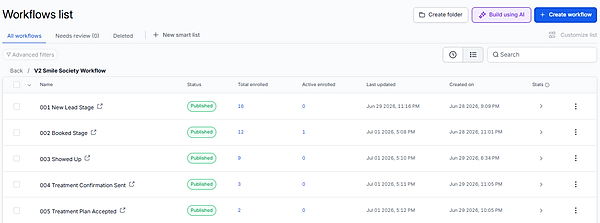
A 5-stage pipeline and 9 published workflows that take a website visitor to a booked, reminded consultation with no manual follow-up.
- How the page moves a visitor from problem to booked consult in one path
- The trust and services sections that get visitors ready to book
- The native GHL calendar that books and triggers follow-up automatically
How a dental clinic can connect its website, calendar, pipeline, and follow-up into one booking system built around the customer journey.
Self-directed demonstration project — not a paid-client performance claim.
Summit Shield Insurance — lead-to-policy CRM
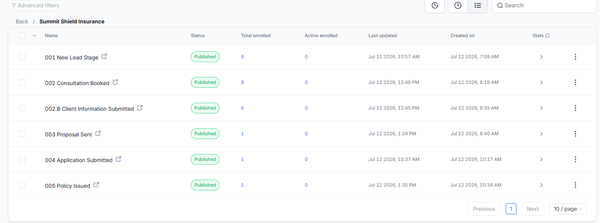
A 5-stage pipeline and 6 published workflows connecting inquiry, consultation, proposal, application, and policy onboarding — plus full implementation documentation.
- The insurance website and its path from visitor to consultation
- The five-stage lead-to-policy pipeline inside GoHighLevel
- Six workflows that automate follow-up and internal handoffs
How an insurance team can manage the journey from inquiry to policy onboarding without relying on disconnected inboxes or memory.
Self-directed demonstration project — not a paid-client performance claim.
See how the CRM was structured, documented, and handed over.
The 28-page guide covers the pipeline, six workflows, operating procedures, troubleshooting, maintenance, and evidence-based QA. Anything without supporting test evidence is marked Not Confirmed.
Nine examples, built inside GoHighLevel.
Explore nine common automations. Each example shows the business problem, workflow logic, and intended outcome.
The essentials, in one place.
What a workflow is made of, and why most self-built ones break.
The building blocks
- Trigger — the event GHL is watching for: a form submitted, a call missed, a stage changed, a tag added.
- Actions — the actual work: send an SMS or email, create a task, move a pipeline stage, notify someone.
- Conditions — the if/else branches that handle real situations instead of one happy path.
- Wait steps — timing that makes follow-up feel like attention, not a robot.
Where DIY builds break
- No condition for "they already replied" — reminders keep firing after the lead responded.
- Same timing for every contact — no business-hours logic means 2 a.m. texts.
- Tags pile up with nothing reading them — three workflows tag, nothing in the pipeline uses it.
- Never tested end to end — published after a glance, not walked through as a real customer.
Want this mapped for your business, specifically?
Every build starts with a plan you can see before anything gets touched inside your account.